
Growing up, I often felt that my thoughts and opinions were irrelevant. Whenever I tried to express myself, people found it difficult to understand what I was saying because of the way I spoke. I found it difficult to communicate my thoughts coherently, and I often rushed my words as though I were eating hot yam.
Because people couldn’t understand most of what I said, they sometimes dismissed my contributions. It affected me so much that I almost stopped talking altogether and turned to writing as a way of expressing myself.
Looking back, I realize how much our experiences can influence the way we see our voices. When you repeatedly feel unheard or dismissed, you begin to question whether what you have to say is worth listening to.
You might have gone through a different fear of expressing yourself that it makes you hesitate even when you have a brilliant idea. You want to contribute to a conversation, but you are worried that your words won’t come out the right way. The truth is we have something meaningful to say. What just hinders us is that we did not develop the confidence to speak up and always chose silence.
Why Do People Struggle to Express Themselves?
There are several reasons people find it difficult to use their voices.
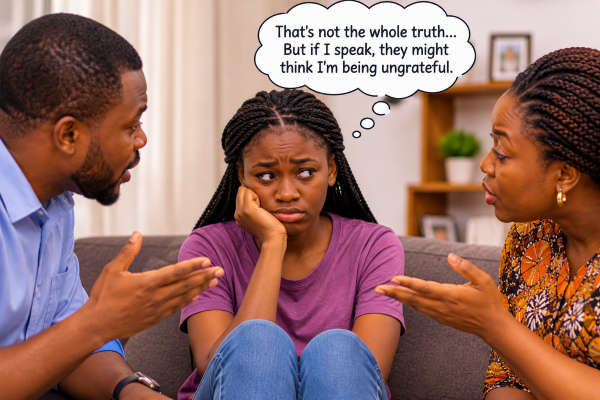
- Having your thoughts dismissed: If you lived in a family or an environment where people you loved and respected repeatedly ignored, ridiculed, or interrupted you, you gradually began to develop that fear of expressing yourself. Without being told, you immediately assume that nobody wants to hear what you have to say. Eventually, you stop contributing to conversations. This can be more difficult when you experience it in childhood. At that time, you are still developing your ability to communicate and understand yourself. Then it affects how comfortable you feel about expressing your thoughts as you grow older.
- The fear of being judged: We sometimes hold back our thoughts because we are afraid of saying the wrong thing or sounding unintelligent. Think about having an idea during a meeting but keeping quiet because you aren’t sure how others will receive it. You spend so much time questioning yourself that the opportunity to contribute passes. The possibility of being criticized becomes so overwhelming that you choose silence rather than risk being judged.
- Comparing ourselves with others: Have you ever listened to someone speak so confidently that you immediately began questioning your own ability to communicate? They seem to express their thoughts effortlessly and always seem to know the right things to say. Then, this makes you feel inadequate, thinking that you aren’t as articulate or knowledgeable as they are. Such comparison can make you overly critical of your communication abilities. You begin to measure your contributions against those of others and assume that you have less to offer. Ultimately, the fear of expressing yourself develops in a greater dimension.
- Being overly conscious of how you communicate: Some people struggle to express themselves because they are constantly thinking about how they sound. They worry about their choice of words, pronunciation, grammar or ability to communicate coherently. For instance, someone might have a good contribution to make during a conversation but become distracted by the possibility of stumbling over their words. They keep rehearsing what they want to say, only to lose their train of thoughts when it is finally their turn to speak. This constant self-monitoring can make communication feel like a performance rather than an opportunity to just exchange thoughts.

How can we Become More Confident in Using our Voices?
Apart from knowing why we hesitate to express ourselves, it is important that we begin to create opportunities where we become comfortable communicators. Here are some practical ways:
- Stop dismissing your own thoughts: You’ve become so accustomed to letting other people dismiss your opinions that you have started to do it to yourself. You have an idea but immediately assume it’s not good enough. You need to challenge that habit. Your thoughts don’t have to be extraordinary before they deserve expression. You don’t have to know everything about a subject before asking a question or sharing your perspective.
- Give yourself room to make mistakes: No one is Mr./Mrs./Miss Perfect in this world, and you cannot assume that role. You might stumble over your words or struggle to explain an idea. That doesn’t mean you should stop trying. Communication is a skill that improves with practice. You don’t have to deliver perfect sentences every time you speak. Allow yourself to learn and become better along the way.
- Find ways you communicate best: Some people express themselves better through writing. Others prefer one-on-one conversations or need time to organize their thoughts before speaking. Find the ways that allow you to communicate comfortably, while you remain open to improving your communication skills. The goal is to become more confident in expressing yourself, not to be someone else.
- Practice expressing yourself: Throw away that fear of expressing yourself and start communicating with people every day. Share your opinion during a conversation, ask questions when you don’t understand something or contribute an idea during a meeting. You don’t have to start with a public speech or a difficult conversation. When you have an opportunity to speak, just do it. It gradually becomes easier to use your voice at bigger, more intense situations.
Your Voice Deserves to Be Heard
I’m not saying you should be the loudest in the room to have a voice. Neither do you need an impressive vocabulary or perfect arguments before you can express your thoughts. Your opinions will not always be right, and not everyone will agree with you. That shouldn’t stop you from speaking because everyone is just like that. When you have something to say, give yourself the confidence to say it.
